Project Brief
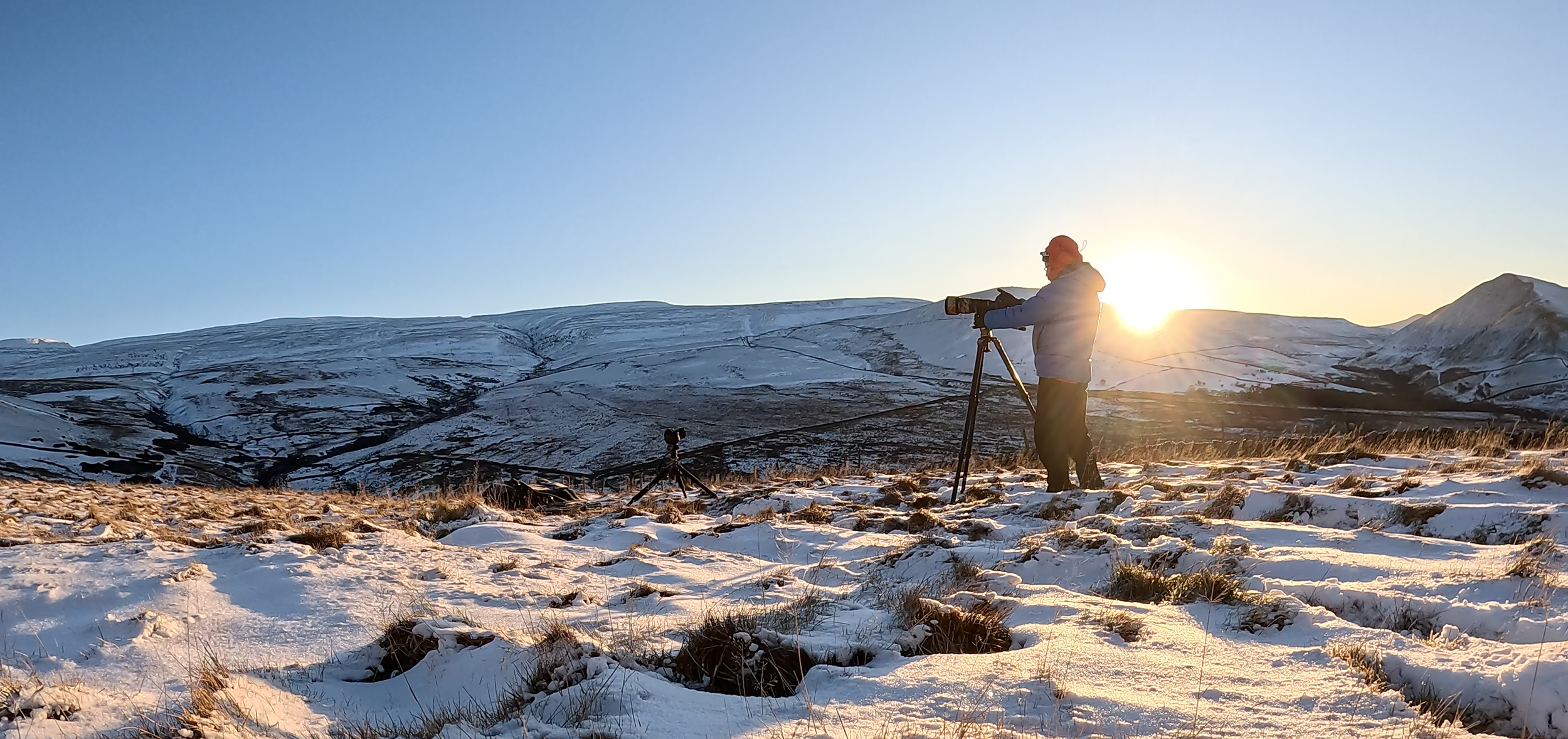
The Author on Knock Pike, North Pennines
Purpose and Context
An exploration of immersive filming techniques: to develop the theme of non-curated wildlife narratives introduced in Semester One.
The focus will be on cinematic techniques which portray a sense of scale, movement and deep-time which I consider to be important in the chosen genre.
The cinematographer, Ron Fricke (2025), explained that the innovative use of immersive filming techniques in the film Koyaanisqatsi (1982) are about “revealing an essence”. Timelapse, slow-motion and stop-motion were used extensively and interconnected with the film’s score to create “better pacing” and introspection.
This semester I shall experiment with the same three techniques:
• Timelapse: to create the temporal sense of passing time- day-to-night, changing weather etc.
• Slow-motion: to create the sense of pacing and grandeur- expansive panorama, birds in flight, flow of water etc.
• Freeze-frame: to create the sense of intimacy: subject stationary in front of a moving background- plant by stream etc.
Feedback from Semester One suggested I use this module to help define what I mean by a non-curated narrative; not just by what is excluded but how the structure, rhythm and progression of narrative can be shaped and enhanced by this approach.
Deliverables
A short film sequenced with examples of the cinematic techniques above, supported by an appropriate soundscape. This film will be broadcast to an audience on campus.
A clear definition of non-curated narratives and how this might become a personal USP. Research will include the use of cinematic techniques in mainstream films and how this amplifies their narrative.
Detailed checklists to overcome the technical and logistical challenges encountered in the field, as well as illustrate the creative opportunities.
Undertake primary research into public understanding and potential engagement with non-curated wildlife films and/or soundscapes.
A BTS video in support of the final screening.
Record of learning and reflection through an online journal hosted on my website.
Challenges
The reality of wildlife recording:
As a wildlife filmmaker and sound recordist, working in upland, weather battered Cumbria, the logistical challenges of accessing, locating and recording sparse and shy subjects are multiple and can be intense. Planning needs to be thorough, and a mindset developed to cope with disappointment. When opportunities arise, they need to be executed effectively, and steps taken to reduce mistakes being repeated. This is what the eminent surgeon Gawande (2010, p.8) refers to as “errors of ineptitude” which can be reduced through use of checklists and preparation.
Senescence:
Bampa et al, (2022) define metacognition as a person’s ability to monitor and influence thinking processes. Older people tend to be overconfident about their thinking strategies and therefore can be reluctant to adapt by adopting new cognitive strategies. Checklists can be an effective “habit-of-mind” strategy (Stine-Morrow, 2007) with the potential to reduce the natural impact of senescence.
Spring Season:
The module coincides with the spring months, a key period for recording wildlife. It is envisaged that the final project will have wildlife front and centre, telling their own story, with the landscape and weather serving as narrative context. Following feedback from the group seminar I will revisit how this can be achieved while ensuring the brief for this module is fully met
Timeline
A Gantt chart has been appended to the brief. In response to the challenges considerable time is devoted to recording in the field including an intensive period over the Easter break when camping in location. This will provide timely access to the subject matter and opportunity for a focused BTS production. Breaks in schedule due to adverse weather etc will be used for homebased research, editing and journalling.
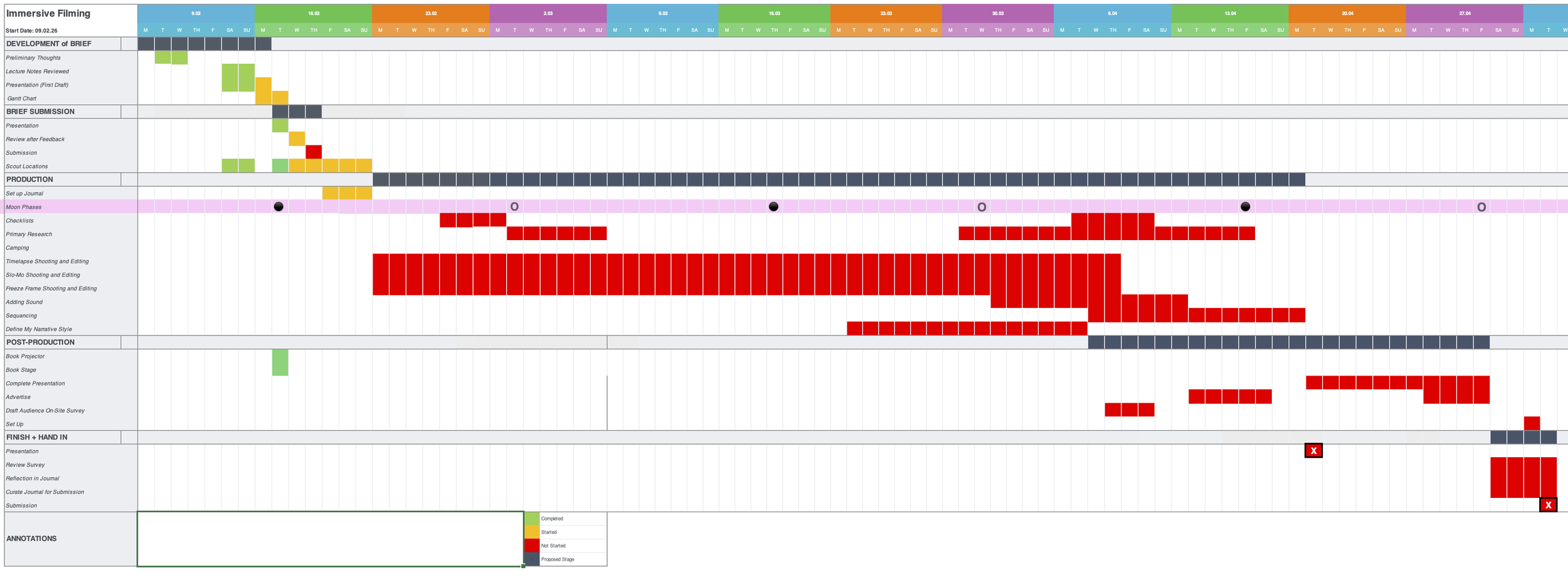
Gantt Chart for Project
References
Bampa, G. et al. (2022) ‘Metacognitive Scales: Assessing Metacognitive Knowledge in Older Adults Using Everyday Life Scenarios’, Diagnostics, 12 (2410), pp. 1-13.
Fricke, R. (2025) Ron Fricke On The Making of Koyaanisqatsi, Interviewed by Journey To The Centre of Cinema Channel. Available at: https://www.youtube.com/watch?v=aAr1NWRfVAk Accessed: 10 February 2026)
Gawande, A. (2010) The Checklist Manifesto: How To Get Things Right. Profile Books Ltd.
Koyaanisqatsi (1982) Directed by G. Reggio. [DVD]. Metro Goldwyn Mayer
Stine-Morrow, E. (2007) ‘The Dumbledore hypothesis of cognitive aging’, Current Directions in Psychological Science, 16(6), pp. 295-299.