Nature-Led Narrative (1)
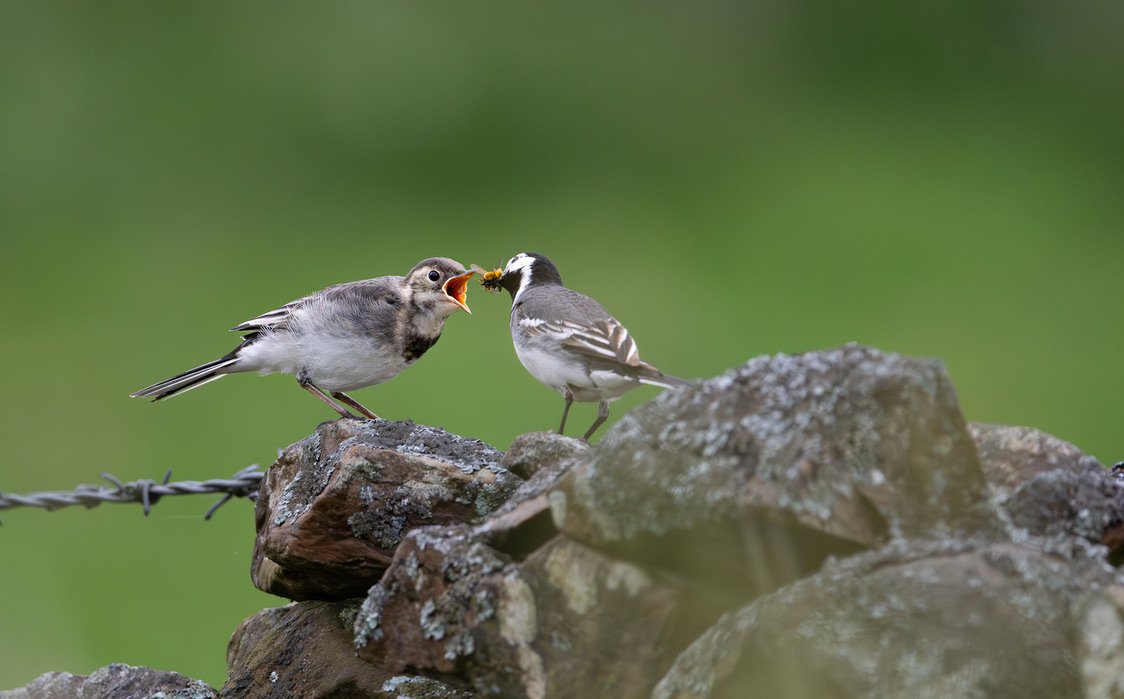
Pied Wagtail feeding young
“For the artist their story, their inner world, is told through their work” (Lieblich et al. 1998).
I am a longtime admirer and avid viewer of wildlife programming: anything by David Attenborough, Spring Watch (and similar), and pretty much all nature documentaries. In awe of the camera work, sound recording and trail craft of the crew I have been inspired, post-retirement, to have a go. However, over recent years I have become less enamoured with the narrative style of much of contemporary wildlife filming. I find the human characterisation of the wildlife to be disrespectful; the story lines clichéd, endlessly repeated and overly dependent on jeopardy; too much emphasis is placed on the personality and backstory of the presenters and crew; and the constant need to claim to be the first, the most remote, the most challenging, the most technically advanced. More in keeping with the genre of heroic adventure filming than nature-led.
A typical example is the very popular BBC Big Cats 24/7 series:
https://www.bbcearth.com/shows/big-cats-247#find-big-cats-24/7-episodes
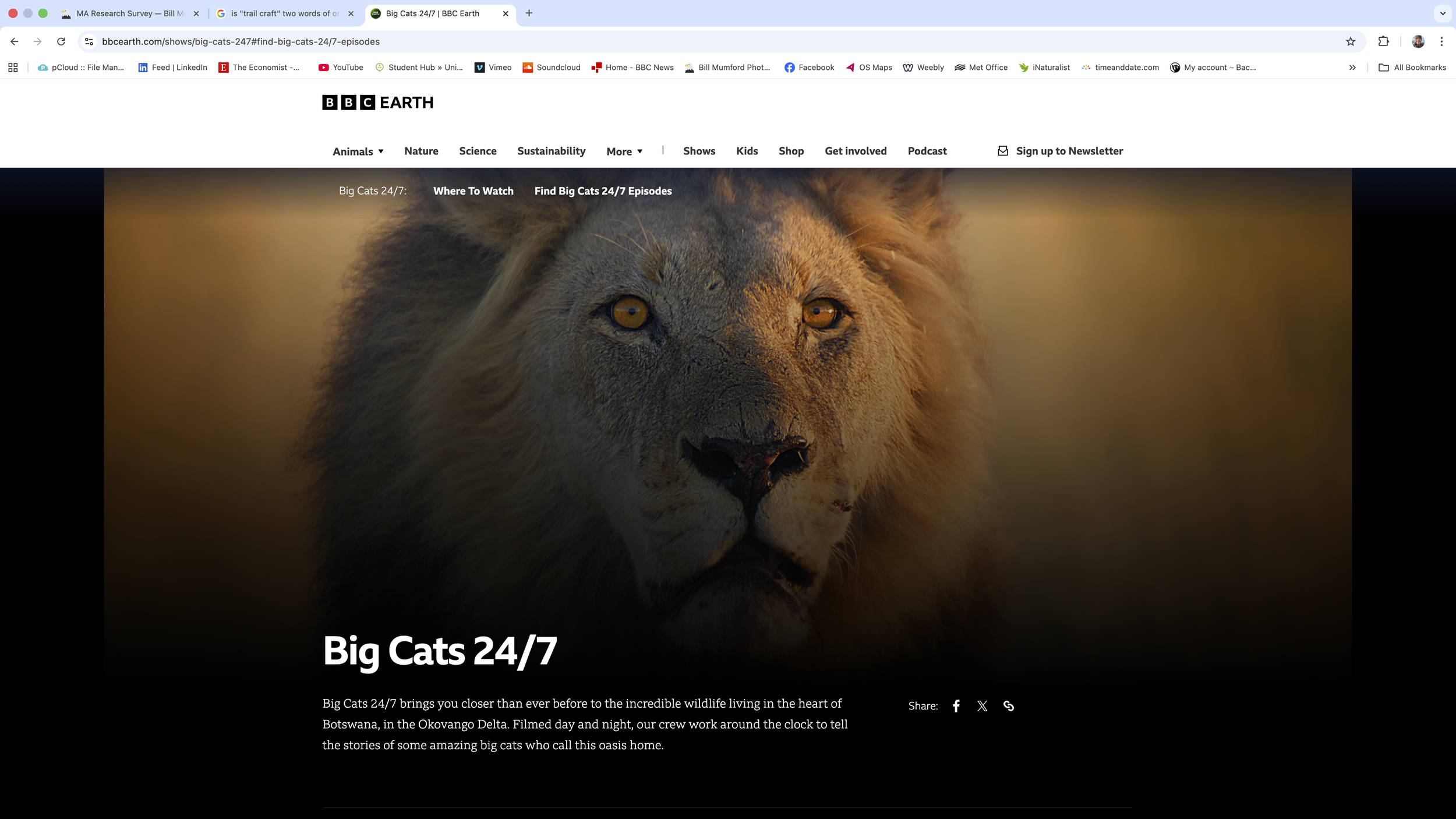
Screenshot of BBC advertisement
Episode One of the first series very quickly establishes the narrative of jeopardy: will the lioness successfully catch prey for her cubs not to starve and for her to be strong enough to protect them against lone males. Anthropocentric conceits are used to build empathy: wild animals are given names “Nosi” and “Big Toe” and “Poco” a; they are ascribed human characteristics such as “streetwise” and the crew often refer to the animals with personal pronouns “who” rather than “which”. Despite close access to the animals and the availability of sophisticated sound recording equipment, non-diegetic music was evident for 75% of the broadcast. Music even overlayered the actual vocalisations of the animals, the tone becoming particularly sinister during night scenes, which, I suspect, plays more to our fear of the dark than those of the wildlife. Then, just in case we are not keeping up with the jeopardy of the plot, the crew reminded us by talking to the animals as they were filming: “…no, no, no pal you are making a big mistake”, “…don’t you know who this is?!”, “…I am worried about the smallest one”. The narrators go on to create a heroic narrative with references to being “the very first time” and using the latest “military-grade” technology with the action taking place in a remote location with exotic dangerous fauna which create jeopardy for the crew creating a sub-plot of human dominance and heroism. A heroic narrative
This portrayal has been termed as a “soap opera” narrative, Somerville et al. (2021) argue: “…a conspicuous pre-occupation with the ‘personalisation’ of individual animals and the injection of false jeopardy…leads to significant misinformation and creates problems for public understanding of wider conservation”.
Some wildlife films have deliberately moved away from this narrative style to make the wildlife more centric to the story.
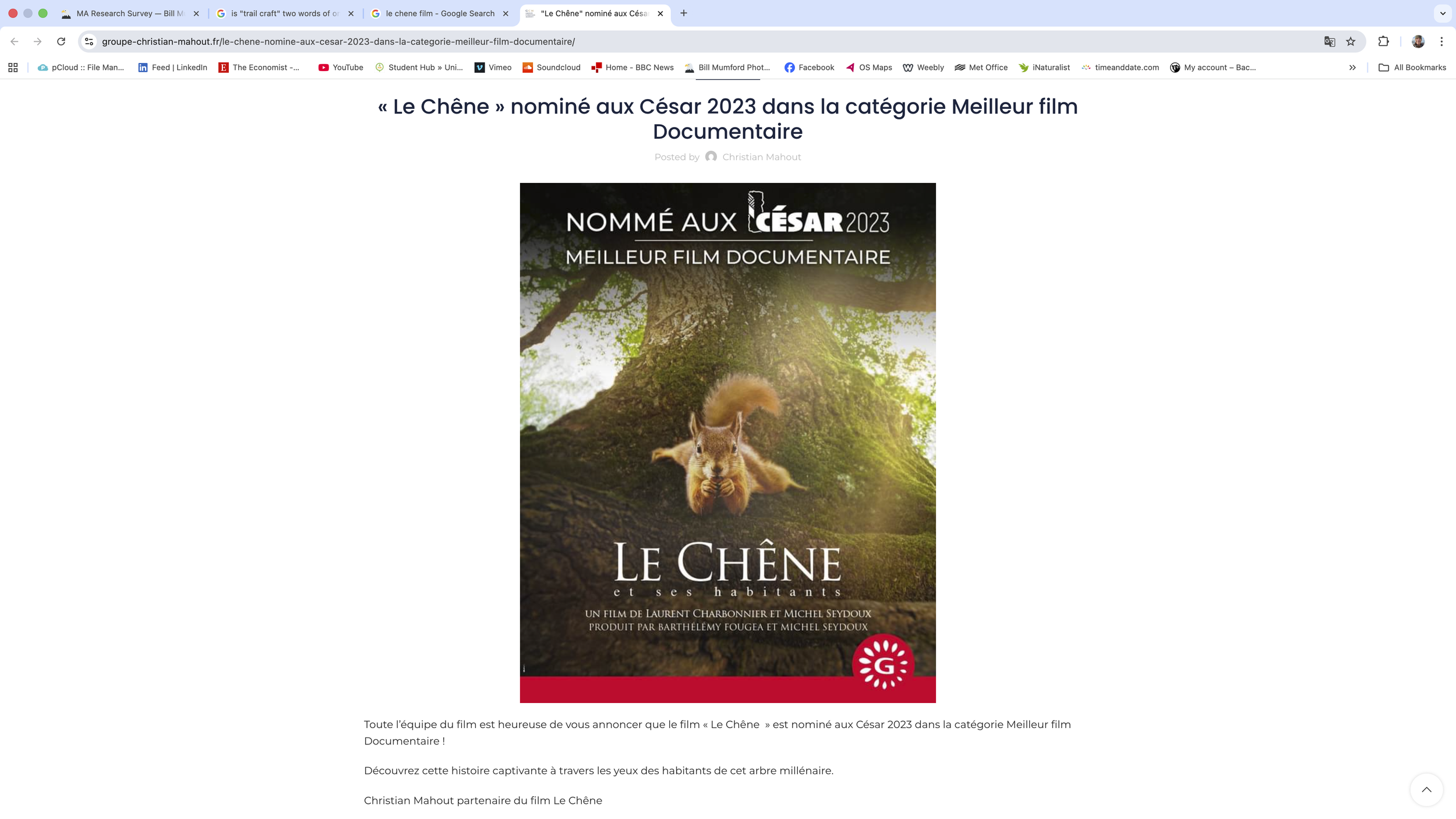
Screenshot of Le Chêne advertisement
The French film Le Chêne (2022) https://www.youtube.com/watch?v=Bb-nHUP9jLM is a good example with the directors Laurent Charbonnier & Michel Seydoux explicitly ruling out narration. They comment: “the more powerfully you are immersed, the more your senses respond… [we] prefer people to think for themselves rather than give too much information”. The lack of a narrator, they contend, leaves the audience free to emotionally respond as they wish rather than as directed. To compensate they worked very hard on the sound design- foley and field recordings and commissioned an original musical score. As a result the film took five years to complete.
In a similar vein, but much lower budget and quicker production, the sound recording Martin Dohrn created: My Garden of a 1000 Bees:
https://www.bbc.co.uk/iplayer/episode/m002t686/my-garden-of-a-thousand-bees
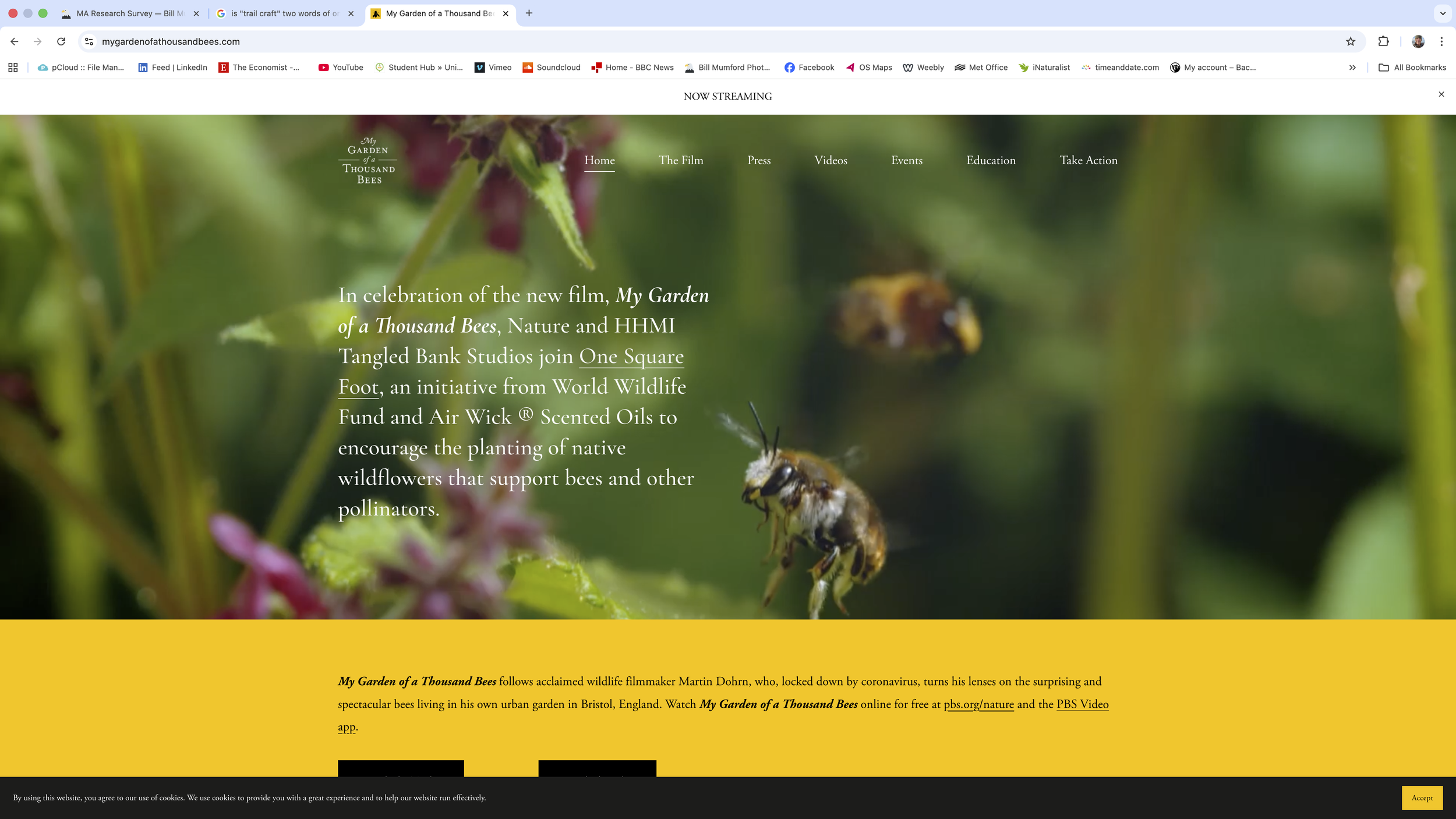
Screenshot of infographic
A self-confessed bee enthusiast he used the experience of the Covid lock-down to make a short, personal documentary of the 60 species of bees resident in his urban garden. Using a gentle, wildlife-centric approach with insightful observation coupled with extraordinary filming and sound recording techniques he successfully engages the viewer in an immersive, wonderous and local world.
References:
Lieblich, A., Tuval-Mashiach, R., and Zilber, T. (1998) Narrative Research: Reading, Analysis and Interpretation, Sage Publications.
Somerville, K. et al (2020) ‘Soap operas will not wash for wildlife’, People Nature, 3, pp. 1160-1165.